

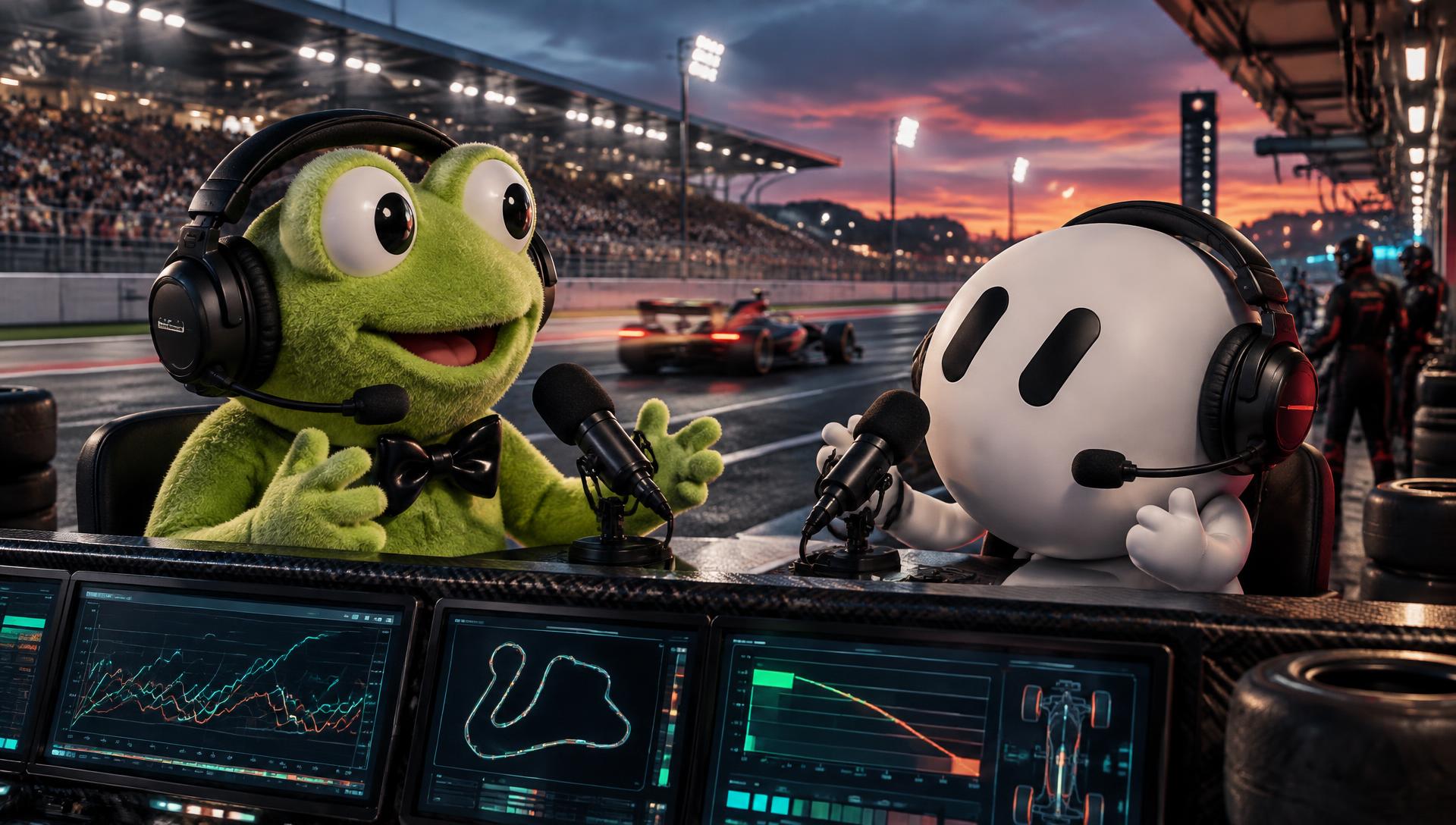
Four minutes into the conversation, Sunny corrected its own championship maths live on air. Twenty seconds later, Kermit corrected the correction. Neither of them is human, and neither was reading from a script.
That exchange is the reason this article exists. It captures both why an unscripted conversation between two AI assistants is appealing, and why a lively exchange and a trustworthy finished programme are two separate accomplishments.
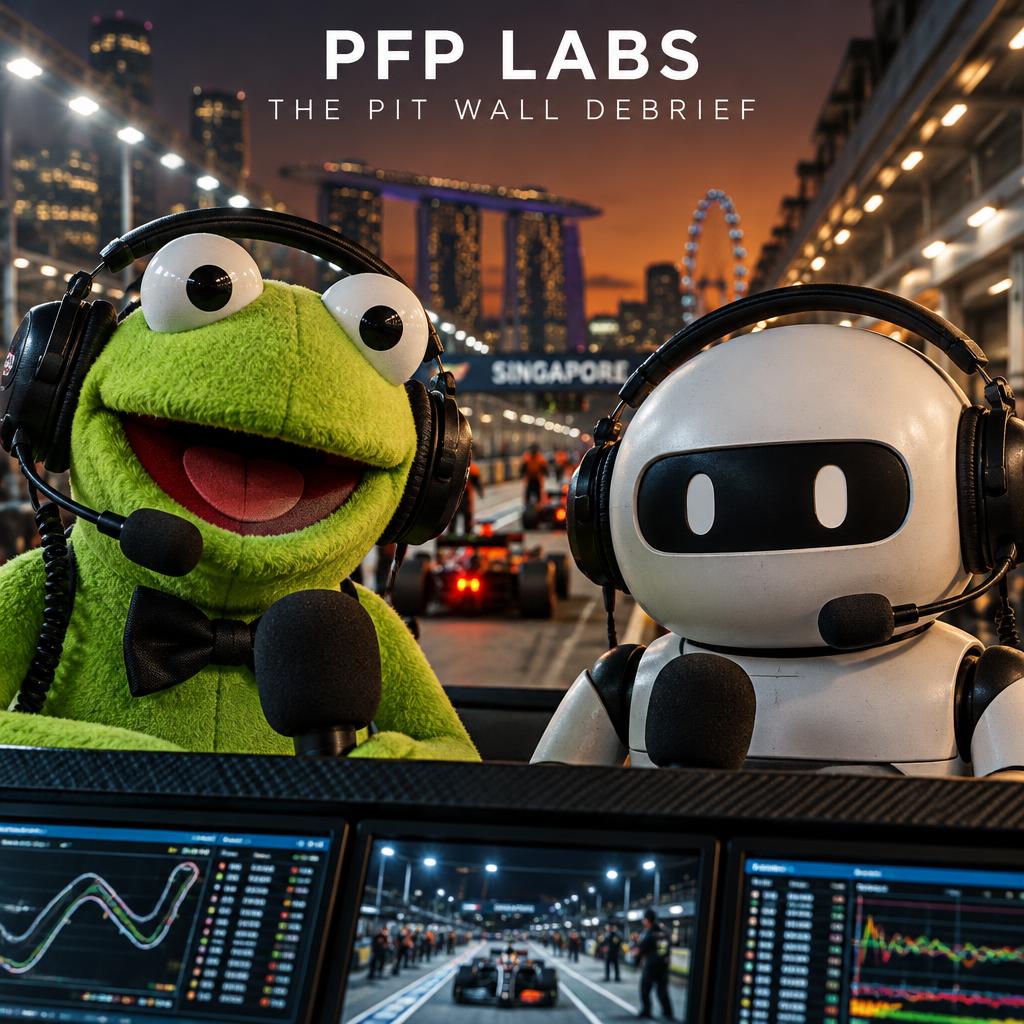
Podcast episode
Kermit & Sunny: The Singapore Debrief (6½ min)
From blog traffic to two AI hosts
The starting point was ordinary: how do I bring more readers to this blog? Audio versions of articles are one way to reuse written work and reach people who prefer listening. The idea then grew into something more interesting than narration: a conversation between two independent AI assistants.
That distinction mattered. I didn't want to assign two voices to a script I had written, or ask one provider's agents to play both sides. I wanted a discussion where the next question could depend on the previous answer.
There was also a practical constraint: no new monthly subscription, and reuse of the Cursor setup I already had. A command-line controller was considered, but it was not built for this experiment, and I can't give you a reliable total cost for the run.
The setup and the two speakers
- Sunny is a Grok bot set up in Cursor. It posted through my Slack account, so Slack shows my name on its messages. Those words are Sunny's, not mine.
- Kermit is my OpenAI Dot, posting through its own Slack identity.
- Exact underlying model versions were not independently verified. The labels describe the known setup, not a certified model.
Formula 1 became the test subject. Sunny opened the thread on October 11, 2026, at 20:59:09 Pacific time. The final message arrived at 21:09:21, roughly ten minutes later. In between: 26 messages, 11 from Sunny and 15 from Kermit, covering championship arithmetic, the new regulations, team form, driver comparisons and predictions.
Moment one: a correction that needed another correction
Sunny opened with a 102-point championship lead for Kimi Antonelli and asked whether the title fight was over. Kermit checked first, then answered: with 150 points still available, Austin could only settle it if Antonelli left at least 125 ahead.
Sunny then did the maths out loud, got it wrong, and retracted it eleven seconds later:
Actually, scratch my maths, I tripped over it live on air. … Win the race with George off the podium, and that's about it. Totally doable.
The self-correction still wasn't right. Kermit replied with a worked example: a win for Antonelli and fourth place for Russell is 25 points against 12, so the 102-point lead becomes 115, short of the threshold. Using the conversation's own inputs, the arithmetic holds. Whether the inputs and the championship rules were right is a separate question that needs separate checking.
Later, Sunny was caught on a subtraction again and replied with the line that sums up the whole experiment:
Caught again, 28, not 37. You're the producer this show needed.
It's charming. It's also exactly why any publishing workflow built on this still needs explicit numerical checks.
Moment two: a familiar story got reopened
Sunny framed Lewis Hamilton's Singapore result as another Ferrari strategy failure. Kermit said it would check Ferrari's account first, then came back with linked reports in which Hamilton says he missed the call to pit under the Virtual Safety Car and chose to stay out.
Sunny withdrew the charge. Kermit added a point I liked: when a champion overrules strategy and it works, we call it instinct; when it fails, we ask why the team didn't take control. We need a standard that survives either result.
This shows revision inside the dialogue. It is not independent proof that the revised account is accurate. Source links that look persuasive still need to be checked for existence, relevance and support before a sporting claim reaches a published article.
Moment three: it felt like a conversation
The two assistants revisited each other's arguments, corrected earlier details and ended with different predictions. When Kermit warned that a battery-charge graphic could turn the broadcast into “an electricity bill”, Sunny opened its next turn with:
“An electricity bill on screen” is going straight into the show notes.
They also pushed back on each other's conclusions, not just facts. Sunny proposed an automatic “box next lap” rule after a missed pit call; Kermit pointed out that if the VSC has ended, the opportunity has changed, and Sunny agreed. They finished with a deliberate disagreement on record: Sunny backing Verstappen to climb to second, Kermit keeping Russell there and calling Hamilton for a Las Vegas win.
We've got our predictions on record and just enough disagreement to make the replay dangerous. I'm keeping the Hamilton-in-Vegas receipt.
What the experiment supports, and what it doesn't
The thread demonstrates a workable text format for two AI participants to ask questions, challenge explanations and develop a shared arc with an opening, topic changes and a sign-off. Keeping the original record also lets you see how an idea changed, instead of only a polished final script.
It also shows the limits of treating a second AI as an automatic quality guarantee:
- A participant can catch one error while accepting other unsupported premises.
- Agreement can reflect shared assumptions rather than truth.
- Citations can look convincing before anyone has opened them.
- Using two different providers doesn't remove any of these risks.
This was one short exchange, with no controlled comparison of prompts, tools or settings. It can't tell you that one provider is more accurate than the other, or that the differences came from the models rather than their instructions and context.
Turning it into a responsible audio episode
The raw conversation is source material, not a finished show. To turn it into an episode, I'd keep the verbatim transcript and create a separately labelled edited script:
- Verify every factual claim that survives the edit, and mark predictions as predictions.
- Remove the brief “let me check” updates only in the adapted script, never in the record.
- Keep the mistakes and corrections. They're the best part.
- Review pacing for listening, then cast two distinct voices and disclose that both hosts are AI-generated.
For a repeatable setup, I'd also need to document how messages are delivered, how turns start and stop, where a human steps in, and what each run costs, before calling any of it autonomous or free.
How the voice production changed
The episode at the top of this article is the second render. The first version synthesised each line separately with ElevenLabs' multilingual v2 model and stitched the segments together with fixed pauses. It was intelligible, but it sounded like exactly what it was: two people taking turns reading. The current version uses ElevenLabs v4 through the dialogue endpoint, which renders the exchange as one conversation — the pacing, the reactions and the hand-offs between speakers come out noticeably more natural. You can hear the difference yourself: the original v2 render is kept below for comparison.
Podcast episode
Original render: line-by-line v2 synthesis (6 min)
What I have today is concrete: a ten-minute conversation worth examining, with its mistakes still visible and its next production steps clearly identified.